

THE AGRARIAN TERRAIN
Its origin, constitution and properties
by Prof. Fausto Sestini
by Prof. Fausto Sestini
History
It is a technical and scientific work that explores the characteristics and processes associated with agricultural land
The book, published in the early 1900s, is still an important reference for agronomists, agricultural science students and agricultural professionals, but also for anyone who wants to better understand the scientific basis of cultivation and soil management.
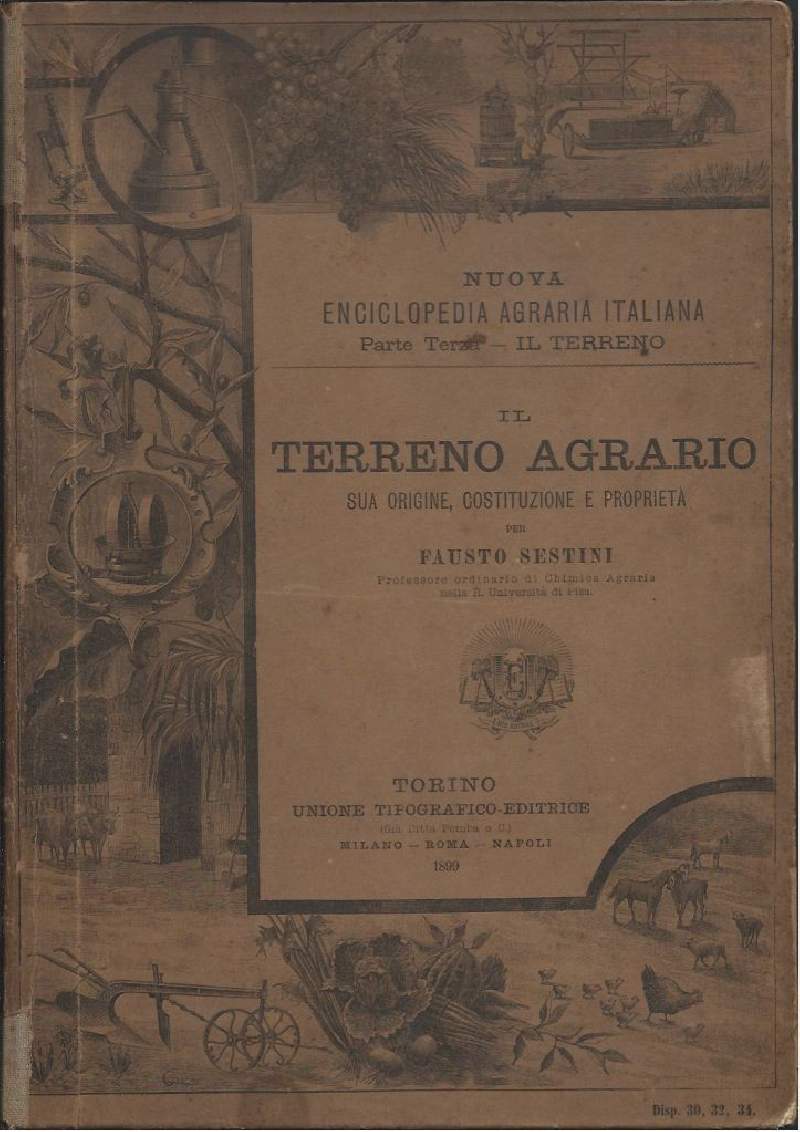
Here are the main themes it addresses:
1
Soil origin
Analyses the geological, chemical and biological processes that lead to the formation of agricultural soils, with a focus on parent rocks and their disintegration.
2
Soil Constitution
It delves into the physical and chemical composition of soil, considering soil profile layers, structure, texture and different soil types.
3
Soil properties
It discusses fundamental properties such as water-holding capacity, aeration, chemical and biological fertility, and the ability to support plant growth.
4
Biological and chemical factors
It analyses the interaction between soil and microorganisms, the nutrients present and their availability to crops.
5
Importance for agriculture
It focuses on the role of soil as an essential resource for agriculture, describing practices to improve its quality and long-term sustainability.
6
Practical aspects
It includes useful tips for farmers and scholars, such as soil testing methods, fertility improvement techniques and approaches for efficient agricultural management.
The story of Professor Sestini Fausto Alessandro
Professor Fausto Sestini can be described as a pioneer of Italian agricultural chemistry, a hybrid profile between applied scientist and visionary technician at the service of the country’s agricultural progress.
He was a multifaceted and pragmatic personality:
- Experimental chemist, always connected to concrete reality (from wine quality to water analysis, from santonine to boric acid).
- A passionate teacher who inspired generations of students (like Raffaello Nasini and, indirectly, Primo Levi).
- Didactic innovator, author of school texts of fundamental importance for the dissemination of chemistry in Italian technical schools.
- Institutional advisor, worked at the Italian and World Exhibitions and then as Central Inspector of the Ministry of Agriculture.
- A critical and forward-looking voice in the chemical industry, with a “pre-ecological” sensibility for the use of natural resources.
In short, a pioneer of the multidisciplinary scientific approach with a clear mission: to put chemistry at the service of agricultural development, technical education and a united Italy.